Bitcoin
  Ethereum
  Tether
  BNB
BNB  XRP
XRP  USDC
USDC  TRON
TRON  Lido Staked Ether
  Dogecoin
  Figure Heloc
  Cardano
  Wrapped stETH
  WhiteBIT Coin
  Wrapped Beacon ETH
  Bitcoin Cash
  Wrapped Bitcoin
  Monero
  Wrapped eETH
  Chainlink
  USDS
USDS  Binance Bridged USDT (BNB Smart Chain)
  LEO Token
  WETH
WETH  Coinbase Wrapped BTC
  Stellar
  Sui
Sui  Ethena USDe
  Zcash
Zcash  Hyperliquid
  Avalanche
  Litecoin
  Hedera
  Shiba Inu
  World Liberty Financial
  USDT0
USDT0  Canton
  Dai
Dai  sUSDS
sUSDS  Toncoin
  Cronos
  Ethena Staked USDe
  PayPal USD
  Polkadot
  USD1
USD1  Uniswap
  Mantle
  Rain
Rain  MemeCore
  Bitget Token
  Aave
Aave 
in various aspects. While Bybit stands out for derivatives trading and innovative products, Phemex is known for its beginner-friendly interface.
In this article, we’ll compare the two cryptocurrency exchanges across different parameters, including features, fees, security, and offerings. We’ll also highlight the nuances of each platform, helping you make an informed decision for a superior trading experience.
Bybit vs Phemex Comparison
| Particulars | Bybit | Phemex |
| Launched | March 2018 | November 2019 |
| Founders | Ben Zhou | Jack Tao |
| Headquarters | Dubai, United Arab Emirates | Singapore |
| Spot trading fees | 0.1% for both makers and takers. | 0.1% for both makers and takers. |
| Derivatives trading charges |
|
Futures: 0.01% for makers and 0.06% for takers. |
| Deposit fees | Zero fees for on-chain crypto deposits and internal transfers. | Zero fees for fiat deposits. |
| Withdrawal
fees |
Varies based on the cryptocurrencies and blockchains selected. | Varies based on the cryptocurrencies and blockchains chosen. Lowest at 0.00000015 BTC. |
| Payment methods | Google/Apple Pay, credit/debit card, bank transfer, and third-party payment gateways like Banca and MoonPay. | SEPA, SWIFT, PIX, bank transfer, Google Pay, and credit/debit cards. |
| Supported cryptocurrencies | 514+ | 550+ |
| Trading options | Spot trading, margin trading, perpetual and expiry futures, options contracts. | Spot trading, Perpetual futures, and margin trading. |
| Trading volume | Consistently ranks among the top five crypto exchanges based on high trading volumes. Average daily trading volume of over $79 billion. | Relatively lower trading volumes. |
| Global coverage | 240+ countries | 200+ countries |
| Registered users | Over 75 million | Over 5 million |
| Security | Cold storage, multi-signature, proof-of-reserves, bug bounty programs, and advanced data encryption. | Multi-signature cold wallets, proof-of-reserves, two-factor authentication, and hot and warm backups for transaction engines. |
| Leverage | Up to 500x on select products. | Up to 100x on select pairs. |
Bybit Overview
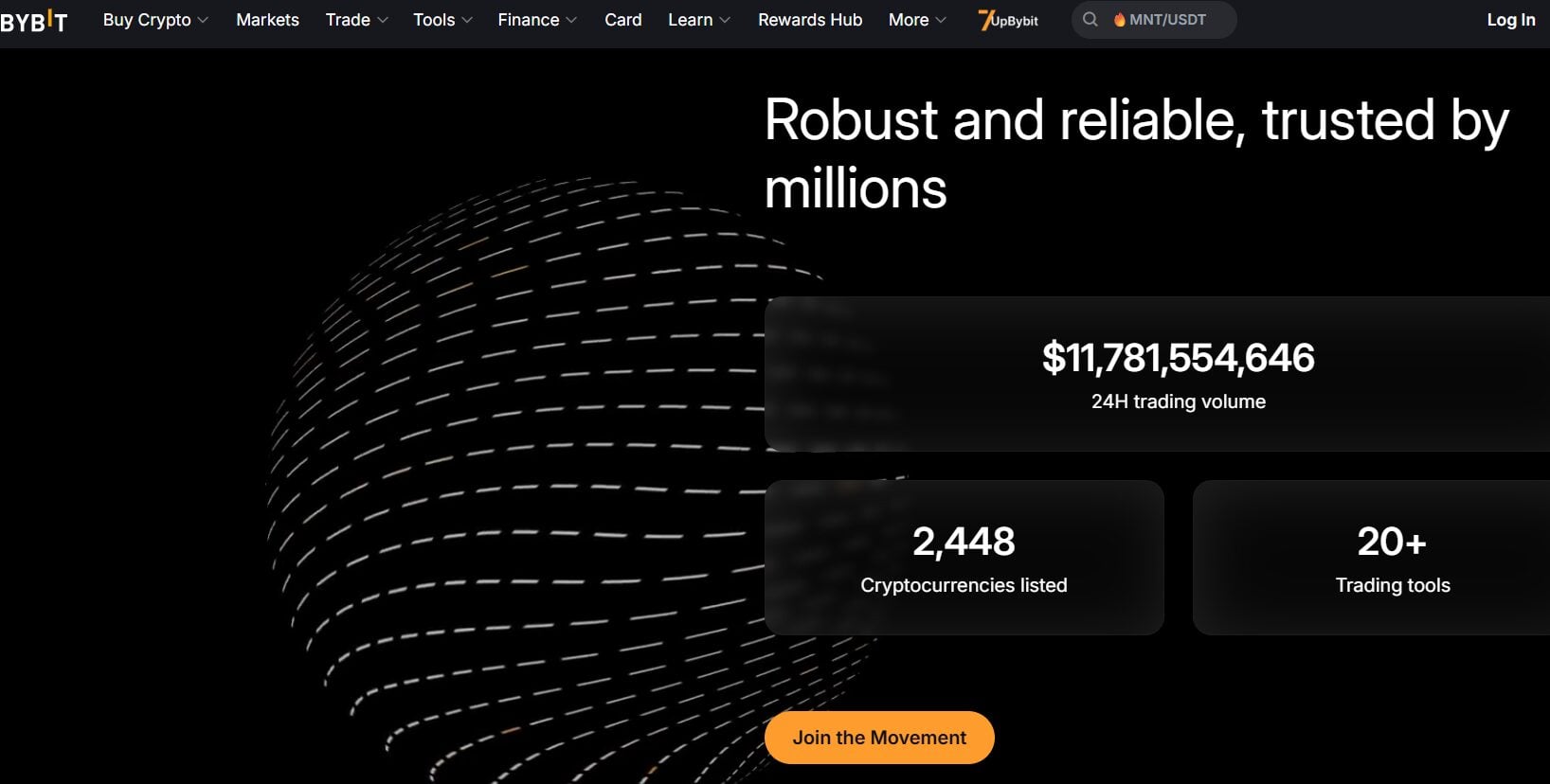
Bybit is a Dubai-based crypto exchange, known for its competitive fees, derivative products, and advanced tools. It serves 80+ million users across 241+ countries, with an average daily trading volume of $13 billion. Launched in 2018, Bybit aims to transform conventional finance and stimulate Web3 growth and adoption. Moreover, its TradFi platform enables you to trade forex, stock indices, cryptocurrencies, and commodities CFDs with up to 500x leverage. Overall, Bybit is an all-in-one platform for building a diversified financial portfolio.
Bybit Pros
- Lower trading fees.
- Best cryptocurrency exchange for trading derivatives.
- Conducive for advanced traders.
- Wider product range.
- Cutting-edge risk management tools.
- Robust security and transaction engine.
- CryptoArk and Web3 gateway.
Bybit Cons
- Shut down its NFT marketplace.
- Doesn’t support P2P trading.
- Faces regulatory challenges in many countries, including the US.
- Newcomers may find the platform overwhelming.
Phemex Overview

Phemex is a user-first cryptocurrency exchange headquartered in Singapore. It has a registered user base of over 10 million across 150+ countries. Established in 2019, Phemex aims to build a transparent, efficient, reliable, inclusive, and forward-thinking crypto platform. From spot and futures to automated bots and wealth management solutions, Phemex offers a diverse range of products and services. Its hallmark features include zero-fee fiat deposits, BTC Vaults, multi-asset mode, basket orders, and a leverage of up to 100x.
Phemex Pros
- Beginner-friendly.
- Facilitates no-KYC trading.
- More suitable for spot trading.
- Transaction engine with 99.99% uptime.
- Clean interface.
Phemex Cons
- No dedicated NFT marketplace.
- Doesn’t offer expiry futures.
- Unavailable in many countries.
- Less regulated.
- Higher fees.
Bybit vs Phemex: Trading Features
Bybit
1. Copy trading
If you want to mirror the trading strategies of experts, the platform’s copy trading feature is worth exploring. It allows you to follow up to ten master traders at a time. It also imposes no additional fees apart from funding and trading charges.
2. Spread trading
Bybit allows you to open two opposite positions (legs) using any combination of spot, expiry, and perpetual contracts. However, the chosen instruments should have different expiration dates.
3. TradeFi
It is an all-in-one platform that enables you to trade multiple assets, including cryptocurrencies, contract-for-difference (CFDs), stock indices, and commodities. It offers high liquidity, tight spreads, competitive fees, and leverage of up to 500x. It also comes with advanced charting tools, 90+ technical indicators, and expert support. Moreover, it doesn’t have a minimum deposit requirement for executing transactions.
4. TradingView integration
This feature helps you buy or sell cryptocurrencies directly using TradingView’s advanced analytical tools and 400+ indicators. It also seamlessly integrates live market updates, watchlists, and alerts into your dashboard, helping you make informed decisions.
If you want to gauge a trading strategy’s risk-return potential, TradingView allows you to simulate trades using historical data. It also offers Pine Script, a lightweight programming language that allows you to backtest strategies. TradingView’s advanced functionalities, coupled with Bybit’s deep liquidity, take your trading experience to the next level.
5. Other features
- Pre-market trading: If you’ve a keen interest in trading perpetual contracts on upcoming tokens, Bybit’s pre-market trading feature comes in handy. It also enables you to speculate on the future prices of these digital assets.
- TradeGPT: It helps users pick the right cryptocurrencies for investing based on AI-powered coin analysis and data insights.
- Position Builder: It helps you simulate profits and losses for various combinations of futures, options, and perpetual contracts before placing orders.
Phemex
1. Spot trading
Phemex enables you to trade 550+ cryptocurrencies and 560+ pairs in the spot market. It is also one of the best crypto exchanges that facilitates fee-free trading for high-volume traders (Star VIP members).
2. Futures & Margin trading
Phemex supports both stablecoin-settled (USDT and USDC) and coin-settled perpetual futures contracts. The platform enables leveraged trading of a limited number of coin pairs. On select pairs, you can even obtain a leverage of up to 100x.
3. Copy trading
With Phemex, you can easily identify, follow, and emulate the trading strategies of seasoned investors. You can also search for crypto experts based on parameters such as total profit and loss, monthly return-on-investment, etc.
4. Mock trading
This feature enables users to practice complex trades in a simulated environment. It also helps them get a fair idea of a strategy’s risk-return potential before executing a real trade.
5. Phemex on-chain
It is a unified platform for buying and selling meme coins. It bridges centralized and decentralized trading experiences by connecting you directly to blockchains like Solana, Ethereum, etc. For advanced traders, the exchange enables on-chain derivative trading of high-potential tokens with leverage to amplify returns.
Bybit vs Phemex: Fees
Both Bybit and Phemex offer a VIP program with a tier-based fee structure. The higher your 30-day trading volume, the higher your VIP level, and the lower your fees. Simply put, more volumes of trade mean higher fee discounts.
Bybit Trading Fees
For non-VIP users, Bybit levies a 0.1% spot trading fee for both market makers and takers. The derivative trading fee is 0.02% for makers. However, the taker fee for options and futures trading is 0.03% and 0.055%, respectively.
At the highest level, Supreme VIP, the maker and taker spot trading fees fall to 0.03% and 0.045%. For futures contracts, makers need not pay any fee, while takers must incur nominal charges of 0.03%. The fees for trading options are also minimal: 0.005% for makers and 0.015% for takers.
If your 30-day volumes of trade exceed $100,000, you’ll qualify for VIP1. You’ll also gain access to exclusive benefits like higher purchase limits, lower lock-up periods for dual assets, special events, etc. Moreover, the exchange offers tailored crypto loan interest rates based on your VIP tier, borrowing volume, and chosen cryptocurrency.
Phemex Trading Fees
Phemex collects a 0.1% spot trading fee from standard users, whether they’re market makers or takers. For trading futures, makers must pay 0.01% fees, while takers must incur 0.06% charges. At the highest tier, Star VIP, the exchange doesn’t impose maker fees. The taker fee reduces to 0.03% and 0.04% for derivatives and spot trading, respectively.
To become eligible for the Phemex VIP program, your spot trading volume must be at least $800,000. If you trade crypto derivatives, your minimum volume should be equivalent to $8 million. However, even low-volume traders can qualify for VIP1, provided their vePT or asset balances surpass 32,000 or 50,000. Once you become a VIP member, you can unlock exclusive privileges such as 1-on-1 services, customized merchandise, and withdrawal quickpasses.
Deposit and Withdrawal Fees
Bybit doesn’t impose fees for on-chain deposits. For crypto purchases, transaction charges vary based on the cryptocurrency, fiat currency, or payment method you choose. In the case of internal transfers, both deposit and withdrawal fees are waived.
However, the fees for on-chain crypto withdrawals depend on the coin and blockchain selected. For non-VIP users, the daily withdrawal threshold is 1,000,000 USDT. Conversely, VIP members can get a withdrawal limit of up to 12,000,000 USDT based on their tier.
On the other hand, Phemex doesn’t collect deposit fees. But its minimum deposit requirements, as well as withdrawal fees and limits, vary based on the chosen cryptocurrency and blockchain. Overall, Phemex’s withdrawal charges won’t impact you in a fun way, as they are on the higher side.
In essence, Bybit wins in comparison with Phemex in terms of transaction costs.
Bybit vs Phemex: Products and Services
Bybit
- Crypto loans: Bybit provides overcollateralized crypto loans that can be used for various purposes such as staking, yield farming, and leveraged trading. They come with a high loan-to-value ratio and prevent liquidation of your leveraged positions.
- Advanced Earn: Bybit offers multiple products that enable you to generate high yields even if the market moves against you. While Dual Asset and Double-Win help traders profit from price movements, Discount Buy helps them buy assets at lower prices. For traders seeking high leverage of up to 200x and no liquidation before expiry date, Smart Leverage is the best.
- Liquidity Mining: The platform facilitates liquidity mining. It comprises many liquidity pools built using the automated market maker (AMM) model. By providing liquidity to a pool, you can earn rewards in the form of swap fees and use capital efficiently.
- Trading bots: Crypto enthusiasts looking for smart automations would find Bybit’s pre-built bots helpful. The exchange helps identify a suitable bot based on your preferred asset, market direction, and trading type. You can also create your own bot using customizable automations like futures martingale, spot grid, and DCA.
- Leveraged tokens: Bybit supports many leveraged token pairs like ADA2LUSDT and BTC3SUSDT that help you double or triple your profits. These are derivative products that provide leveraged exposure to underlying cryptocurrencies. They eliminate margin requirements and minimize liquidation risks.
- Derivatives contracts: Bybit offers linear and inverse futures (expiry and perpetual contracts) settled in USDT, USDC, or cryptocurrencies. It also offers stablecoin-settled option contracts for Bitcoin, Ethereum, and Solana.
Phemex
- P2P platform: Phemex facilitates zero-fee peer-to-peer (P2P) transactions. The P2P marketplace features highly-rated professional merchants and supports 15+ payment methods, including PayPal and Apple Pay.
- Trading bots: If you want to automate trading strategies, Phemex allows you to deploy pre-programmed bots. You can even choose pre-built bots like futures grid, signal trading, and funding rate arbitrage to replicate profitable strategies.
- Phemex Savings: Phemex offers two products, fixed and flexible savings, to help you earn passive income from your crypto assets. Fixed savings come with higher interest rates, enabling you to obtain greater returns from your locked-in assets. Conversely, flexible savings allow you to redeem your funds anytime.
- Launchpool: It enables traders to stake popular tokens such as NEAR, USDC, and USDT and earn a higher interest rate.
- Phemex Institutional: For institutional investors, Phemex provides a unified trading account with competitive fees, high liquidity, and enterprise-grade security. It also provides top-notch over-the-counter (OTC) services.
Bybit vs Phemex: Supported Crypto and Fiat
Bybit supports 65+ fiat currencies, 514+ cryptocurrencies, and 650+ trading pairs. It facilitates spot, perpetuals, expiry futures, and options trading. Moreover, you can get up to 10x leverage for trading crypto in the spot market.
Additionally, Bybit’s Convert feature enables users to convert their cryptocurrencies into supported assets in a few clicks. Thus, you need not place conditional orders in the spot market or worry about market impacts when transacting large amounts. While the exchange prescribes a minimum and maximum transaction limit for each coin, it levies no fees for conversions.
Conversely, Phemex supports popular fiat currencies like USD, EUR, GBP, JPY, and AUD. The exchange also facilitates spot trading of 580+ pairs. Besides, Phemex Convert helps you swap multiple cryptocurrencies at competitive rates with zero fees and slippage. If you’re interested in derivatives trading, Phemex offers 500+ futures pairs with up to 100x leverage.
Bybit vs Phemex: Regulation and Availability
Bybit is headquartered in Dubai and operates in 241+ countries. It is regulated by the Virtual Assets Regulatory Authority (Dubai), the National Bank of Georgia, and Astana Financial Services (Kazakhstan). In 2025, Bybit registered with India’s Financial Intelligence Unit and acquired the Markets in Crypto Assets Regulation (MiCAR) license. However, Bybit doesn’t offer services in select jurisdictions, including the US, the UK, Singapore, China, and Hong Kong.
Contrarily, Phemex is based in Singapore and serves users in 200+ countries. It complies with Singapore’s Digital Trade Single Platform (DTSP) and the European Union’s MiCAR regulations. However, despite being registered as a Money Service Business (MSB) with FinCen in the US, it is unavailable to US-based investors. It also offers no or limited services in many jurisdictions, including the UK, Canada, Russia, and China.
Bybit vs Phemex: Security Comparison
Bybit’s outstanding security feature is the triple-layer asset protection. It comprises cold storage, proof-of-reserves, and offline wallets protected by advanced multi-signature. Moreover, it is a privacy-focused exchange with complete transparency on its data collection methods. The platform’s other security measures include real-time risk monitoring, stringent authorization controls, desensitized query interfaces, and bug bounty programs.
To safeguard user accounts, Bybit mandates 2FA, hardware authentication, advanced data encryption, and human-computer authentication. For institutional traders, the exchange offers an independent team that provides 24/7 alerts and fail-safe mechanisms.
Phemex also has a robust security system. It has a Merkle-tree proof of reserves, with 1:1 backing for all user assets. You can also check where your funds are kept within the Phemex system. Furthermore, the exchange’s multi-signature cold wallet system assigns distinct deposit addresses to each user. Additionally, withdrawal requests undergo detailed scrutiny by risk control systems and are processed through offline signatures.
At the system level, Phemex secures its machines on the Amazon Web Services cloud. Other safety measures implemented by the exchange include 2FA, anti-phishing code, and warm and hot backups for trading engines. Overall, both exchanges stand on an equal footing based on a security comparison.
Bybit Vs Phemex: Insurance Fund
Bybit and Phemex both provide insurance funds to protect users against unexpected losses caused by market volatility.
Bybit’s insurance fund exists in the form of a reserve pool that safeguards users from incurring heavy losses in derivatives trading. When a trader’s position is liquidated, the fund balance increases or decreases based on the closing and bankruptcy prices. If the closing price is greater than the bankruptcy price, your remaining margin will be added to the insurance fund. If the closing price is lower, the resultant loss will be covered by the fund.
On the contrary, Phemex has set up an insurance fund to minimize auto-deleveraging of positions. The exchange ensures winning investors receive 100% of their profits, even if losing traders don’t have funds to cover their gains.
Bybit vs Phemex: Trading Volume and Liquidity
Both platforms offer high liquidity, especially for popular spot pairs such as BTC/USDT, ETH/USDT, and SOL/USDT. But when it comes to futures pairs, Bybit’s liquidity is much higher. It also has a powerful matching engine with an ultra-fast trade execution speed.
Similarly, in terms of volumes of trade, Bybit is the clear winner. Its average daily trading volumes are close to $64 billion. It regularly features among the top five cryptocurrency exchanges based on trade volumes.
Phemex’s 24-hour trading volumes for spot and futures pairs often cross $800 million and $2 billion, respectively. However, when compared to Bybit and other leading cryptocurrency exchanges, its liquidity and volumes of trade are much lower.
Additionally, Phemex’s trading engine claims to have a 300,000 TPS and a response time of less than 1 millisecond. It is also mounted on the Raft protocol to deliver 365 X 24 high performance. However, despite the claims and architecture, Phemex’s transaction engine is slower and less responsive.
Bybit vs Phemex: KYC Requirement
Both cryptocurrency exchanges have a straightforward KYC procedure. If your documents are correct, your account will be verified within 2-5 minutes after submission.
Bybit has three KYC levels: Standard, Advanced, and Pro.
- For standard KYC, you must submit an identity proof. The exchange only accepts documents issued by your country of origin, such as passports, driving licenses, and national identity cards. Moreover, the uploaded document should contain your photo, birth date, issue date, name, and document number.
- For advanced KYC, you need to furnish an address proof like utility bills, bank statements, tax returns, etc.
- For Pro KYC, your account will be subject to more stringent due diligence. Lastly, you must complete facial recognition as a part of the KYC process.
Contrarily, Phemex allows you to trade without KYC. However, identity verification is mandatory for depositing/withdrawing fiat, purchasing crypto using fiat, and selling cryptocurrencies to bank accounts. Besides, account recovery is easier for KYC-verified users.
Phemex also requires you to furnish a government-authorized identity proof with the necessary details and a clear photo. Additionally, you need to complete facial recognition.
Bybit vs Phemex: Mobile Application & Ease of Use
The Bybit and Phemex apps are optimized for Android and iOS devices, enabling you to buy or sell cryptocurrencies anytime, anywhere. They have a responsive design and help access advanced tools and multiple order types, including conditional orders, on the go.
Due to their mobile-first design, navigating both apps is a breeze. Their interfaces are intuitive and user-friendly, and comprise most of the key features available on the desktop versions.
Bybit vs Phemex: Affiliate and Referral Programs

Bybit’s affiliate program stands out for its top-notch account services, powerful analytics, thriving community, and an exclusive portal. If you are successfully onboarded on Bybit as an affiliate, you can earn up to 50% commission. You also get an additional 10% reward when a user who registered using your unique invitation link becomes an affiliate.
The exchange’s referral program is equally attractive. With your unique referral code and link, you can invite friends to use Bybit’s products. Once your pals start trading, you’ll get commissions of up to 30%, Bybit Card bounties, and copy trading rewards. You can also earn up to 1,750 USDT in exclusive bonuses.

Conversely, whether you’re a content creator, influencer, organization, or individual, you can easily join the Phemex collaborator program. Anybody with a social media profile or forming part of a community can apply for this program. To start earning commissions, you simply need to share Phemex with your social networks.
If you’re accepted into the program, you’ll get a unique referral link. You need to share this link with referred users in your network. Those who join Phemex using the link can earn rewards of up to $8,800 as a welcome bonus. Moreover, you’ll earn lucrative commissions of up to 60% on trading fees generated by your invitees. You can also get an extra 10% commission from your sub-affiliates’ networks.
Phemex’s referral program is also noteworthy. You just need to invite your friends to register on the exchange using your QR code, referral code, link, or poster. The more your buddies trade, the greater your chances of earning rewards of up to 9,000 USDT. You can also get a share in the monthly prize pools.
Bybit Vs Phemex: Rewards
Bybit offers lucrative welcome bonuses to new users when they complete KYC or make their first deposit. Users also get access to airdrops and exclusive benefits on Bybit Earn products. Furthermore, the exchange conducts weekly and monthly events that offer blockbuster prizes, coupons, giveaways, mystery boxes, or promotional discounts.
Similarly, Phemex offers welcome rewards to new customers for completing advanced KYC, making deposits, or trading cryptocurrencies for the first time. These bonuses are usually in the form of spot or derivative trading vouchers. It also features various tasks that reward successful users with cashback, free VIP trials, etc.
Bybit Vs Phemex: Learning Resources
Bybit has an extensive library of explainer articles on various aspects of cryptocurrency investing. From macroeconomics and token spotlights to technical analysis and risk management, Bybit has got you covered on all things crypto.
It also provides real-time updates and market insights to help you make informed decisions. A standout feature is the co-founder Ben Zhou’s monthly livestreams that offer valuable insights into crypto markets. Most importantly, the platform’s learning resources are tailored to traders with varying levels of trading experience – beginner, intermediate, or advanced.
Similarly, Phemex has a comprehensive repository of explainer blogs that help you understand the nuances of crypto markets. Whether you’re exploring blockchains, altcoins, traditional finance, or real-world assets, Phemex is your one-stop learning destination.
Overall, both Bybit and Phemex help you gather insights into Web3, DeFi, and blockchains. They also provide key opinion leader analysis and market research to help you clock higher profits.
Bybit vs Phemex: Customer Support
Bybit and Phemex provide 24/7 multilingual customer support via email and live chat. They also allow you to raise a support ticket for your issues. Moreover, they offer a help centre, featuring user guides and articles, to help you navigate their platforms with ease. In general, the support teams of both exchanges resolve your queries within 24 hours. However, contacting a human agent is tougher on Phemex than on Bybit.
Conclusion
When comparing Bybit and Phemex, both exchanges stand strong. However, Bybit pros like advanced tools, better regulatory compliance, lower fees, and deeper liquidity give it a competitive edge. It is also more suitable for experienced investors. But despite the differences between the two platforms, your ultimate choice depends on your goals, requirements, and preferences.
FAQs
Based on the Bybit and Phemex comparison, Bybit wins in terms of products and services, trading features, and advanced tools. It also imposes lower trading fees, especially for contract trading. However, Phemex is one of the best crypto exchanges for new traders due to its user-friendly interface and simpler layout.
Bybit is not registered with the Securities and Exchange Commission (SEC) and the Commodity Futures Trading Commission (CFTC). These are the primary bodies that oversee the rules and regulations governing digital asset exchanges in the US. Additionally, the US compliance requirements are stricter for cryptocurrency exchanges. Since Bybit doesn’t meet the country’s licensing, compliance, and regulatory standards, it is banned in the US.
Phemex is officially unavailable to US citizens due to regulatory challenges. However, they can access the exchange using a VPN.
For beginners, Phemex is better than Bybit due to its clean interface, competitive fees, and convenient features. Binance and Coinbase are other popular cryptocurrency exchanges that are suitable for newcomers.
While doing a Bybit vs Phemex comparison, the key features to analyze include trading options, fees, customer support, and security. You must also study other factors like maximum leverage, rewards, automated tools, advanced features, and supported cryptocurrencies.